Fiberglass Plastic Panel GRP FRP Sectional Water Storage Tank
Category
Product Specifications
Detailed Description & Use Guidance
Overview and Construction
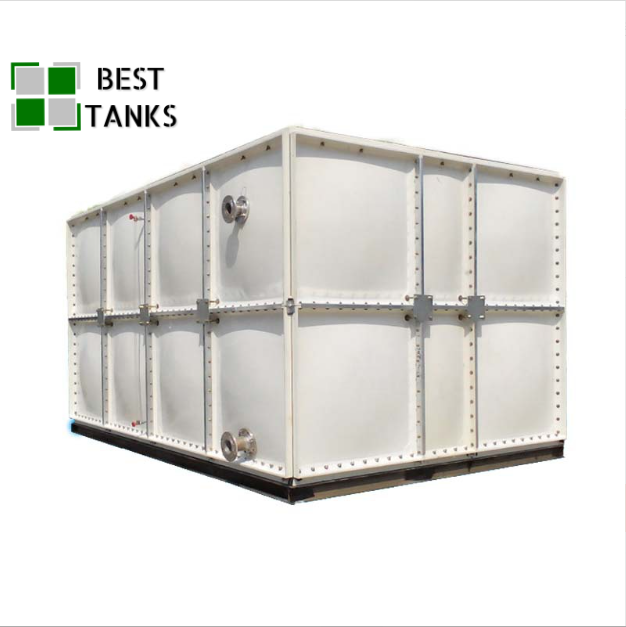
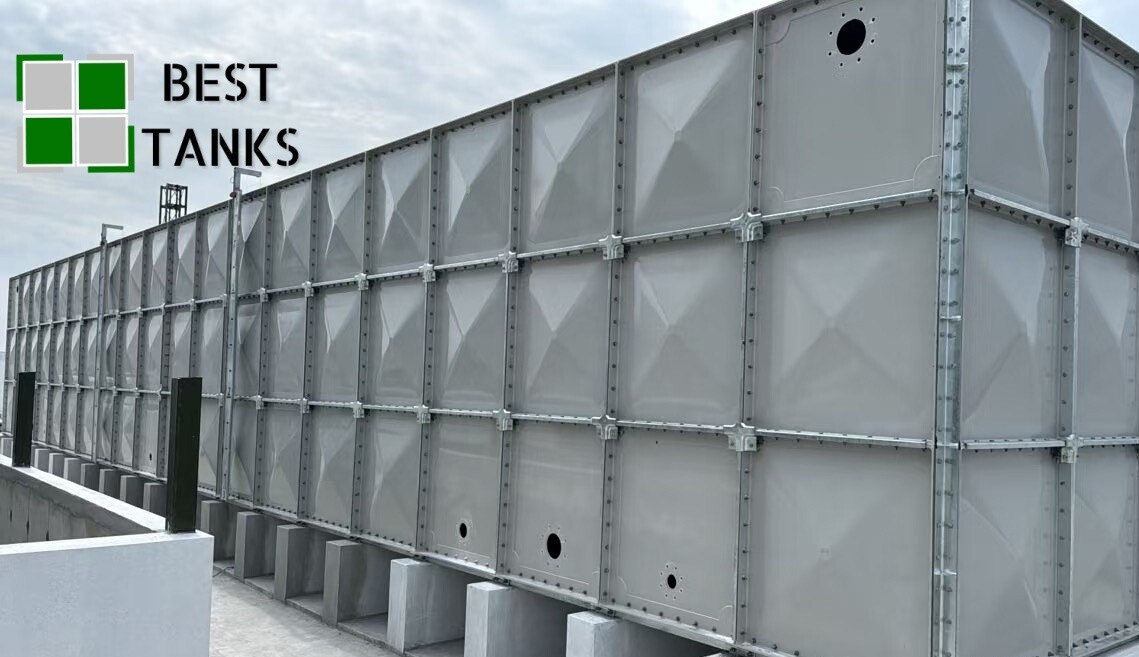
The GRP panel water tank system—commonly described as an SMC modular water tank—is engineered from factory-molded fiberglass-reinforced panels joined on-site with mechanical fasteners and food-grade sealing rubbers. Panels interlock and are clamped by bolts and flanges to form watertight compartments. A supporting base of hot-dip galvanized C-channel rails or concrete slab carries panel loads while internal tie rods and brackets maintain geometry. This sectional approach lowers transport volume, simplifies logistics and enables installation in constrained sites where pre-assembled tanks cannot be delivered intact.
Core Components
SMC Panels
Panels are produced from Sheet Moulding Compound combining continuous and chopped glass fiber reinforcement with a thermoset polyester resin. The composite provides a high strength-to-weight ratio and smooth internal surfaces suitable for potable water when correct seals are used and commissioning protocols are followed. Standard panel sizes and thickness options allow designers to match structural requirements to hydrostatic loads and tank geometry.
Connection Hardware and Seals
Connection hardware is chosen to resist local environmental corrosion: hot-dip galvanized steel for most installations, and stainless steel (304/316) where enhanced corrosion resistance or potable-water compliance is required. Seals use food-grade white EPDM or silicone rubber strips that compress under clamping loads to produce durable, potable-safe joints.
Key Performance Characteristics
The composite panels meet the mechanical benchmarks supplied by the manufacturer: tensile strength ≥ 60 MPa and bending strength ≥ 100 MPa, enabling structural performance with thinner cross-sections compared with many metallic solutions. The bibulous rate ≤ 1.0% and minimum glass fiber content ≥ 25% indicate a controlled manufacturing process delivering low water uptake and reliable long-term behavior when installed to specification.
Advantages vs Conventional Tanks
- Modular Flexibility: configure virtually any footprint or height in 500 mm increments to suit site constraints and expansion needs.
- Reduced Logistics Cost: flat-packed panels lower shipping volume and handling risks compared to large prefabricated tanks.
- Corrosion Resistance: GRP resists many aggressive environments that shorten steel tank life; combined with stainless or HDG fittings, service life is maximized.
- Lightweight Strength: thinner panels reduce foundation loads and simplify base design in many projects.
- Sanitary Installation: food-grade seals and smooth internal surfaces support potable water storage when commissioning and maintenance protocols are followed.
Common Applications and End Users
Typical deployments include municipal service reservoirs, rooftop and basement storage for commercial buildings, HVAC and fire-fighting reserves, industrial process water tanks (with appropriate material compatibility checks), agricultural irrigation modules, and rapidly deployed storage in remote or constrained locations. Primary specifiers and users are municipal engineers, building services consultants, facilities managers, industrial plant designers and contractors seeking corrosion-resistant, adaptable storage solutions.
Installation, Commissioning and Maintenance
- Foundation: verify a level concrete slab or properly supported hot-dip galvanized C-channel base sized to project loads and geotechnical conditions.
- Assembly: panels are bolted with specified torque to compress sealing rubbers. Choose stainless or HDG hardware according to environment and client specifications.
- Commissioning: perform pressure tests, inspect seals, and verify all pipe penetrations and flanged connections before service—especially for potable applications.
- Maintenance: schedule periodic inspections of seals, bolts, support rails and internal cleanliness. Replace any degraded sealing rubber and tighten or replace corroded fasteners to preserve leak-free performance.
Design Considerations and Engineering Guidance
Select panel thickness according to final tank height and hydrostatic load tables provided by the manufacturer. Account for local wind and seismic loads for above-ground installations and detail base rails, joint profiles and pipe penetrations to prevent point loading and stress concentrations. Where stored fluids include chemicals, confirm resin and seal compatibility prior to specifying. The modular nature permits simple replacement of individual panels, but correct detailing at joints and supports is essential for durable performance.
Summary
GRP sectional tanks manufactured from SMC panels offer a transport-efficient, corrosion-resistant and flexible approach to water storage. With defined mechanical properties, food-grade sealing options and a choice of galvanized or stainless accessories, these modular systems meet the needs of municipal, commercial and industrial clients demanding reliable storage with predictable maintenance and rapid on-site assembly. For project specification, use the manufacturer-provided parameters above as the basis for detailed engineering and tender documentation.
Please give us a message
Please fill out the required information as completely as possible. We will respond to you quickly. During business hours, we typically respond within 2 hours, and within 24 hours at other times.


Please give us a message
Dezhou Best Tanks Co., Ltd - is among the top leaders in panel tanks development and manufacturing in China. Best Tanks offers superior service and a wide range of products of GRP water tank ,galvanized steel water tank and stainless steel water tank and all which have passed WRAS and ISO approval.All production processes using machine production, high efficiency and high quality production.
Best Tanks factory is well-known for GRP water tank, pressed steel water tank and stainless steel water tank with 19 years manufacturing experience.
Best SMC and GRP water tanks have been installed in 74 different countries around the world, such as Australia, Tanzania, Sri Lanka, Philippines, Indonesia, Sudan, Nigeria, Vietnam, Thailand, Myanmar, USA, South Africa, Hong Kong, Japan, Malaysia, Singapore, Brunei, Spain, U.A.E, Saudi Arabia, Kuwait, Qatar, Dubai and etc. We eager to push on every time for ultimate customers satisfaction in all over the world and are responding to the needs of the marketplace, offering high value-added products.
Best Tanks is one of the reliable GRP water tank manufacturers, and is highly experienced in manufacturing top quality GRP water storage tanks. We are focused in GRP water tanks used for storage purposes and we also provide high level services for other different usages and industries. We have top class GRP water tank panels in stock to provide to our clients within a short lead time.